COP’s Cash Returns Trail Free Cash Flow by $631 Million
ConocoPhillips’ third-quarter dividends and buybacks were below its defined free cash flow; asset-sale proceeds and the new dividend belong to separate cash-flow questions.
Learn to read the numbers
behind the dividend.
Read how businesses earn, invest and return cash. Explore REITs, BDCs and operating companies through clear guides, transparent tools and real filings.
Open access. Linked sources. No account required.
A short read on company filings, with the facts checked before publication.
ConocoPhillips’ third-quarter dividends and buybacks were below its defined free cash flow; asset-sale proceeds and the new dividend belong to separate cash-flow questions.
3M’s new PFAS settlement separates a present-value accounting charge from a conditional payment schedule extending through 2034.
Keurig Dr Pepper’s nine-month free cash flow exceeded common dividends, while other distributions, lease payments and current obligations remain relevant.
Understand how size, style, sector, structure and dividend policy describe different features of an investment.
Read the introduction →A beginner guide to stock-market labels: tickers, NYSE, Nasdaq, the S&P 500, ETFs and basic trading vocabulary.
Read the introduction →Ready to read company accounts? See how the three financial statements connect.
Follow rent, recurring property spending, AFFO and refinancing. Start with the REIT curriculum or reproduce Realty Income’s historical filing.
Open the REIT filing lab →Study NII, payment-in-kind income, credit marks and funding costs. Work through Ares Capital’s reported income and distribution denominator.
Open the BDC filing lab →Reconcile profit to operating cash, subtract capital spending, then follow dividends and buybacks. Compare scenarios and check an actual cash balance.
Try the Apple cash-flow exercise →Build the foundation. Start with what a REIT owns, how a shareholder gets paid, and the difference between income and investment return.
Open learning path ↗Level 02 / 18 guidesConnect the business to the numbers. Read different property models, then follow the accounting bridge from property operations to common-share distributions.
Open learning path ↗Level 03 / 8 guidesStress the assumptions. Move beyond a single ratio. Connect valuation, refinancing, per-share dilution and dividend funding across scenarios.
Open learning path ↗Level 04 / 4 guidesMake the research reproducible. Work through definition differences, joint-venture ownership, financing timing and competing interpretations in an evidence-led research memo.
Open learning path ↗
Different properties. Different contracts. Different demands on cash.
Explore the sectors →Start with the assets, the income and the shareholder's claim. Then distinguish equity from mortgage REITs, and listed from non-traded or private REITs.
Start here ↗Who pays for the building, why tenant credit matters, and where a long lease can create risk.
Read the lease ↗Understand the reconciliation before comparing payout ratios, valuation multiples or dividend coverage.
Follow the numbers ↗Use the dated SEC reconciliation to rebuild AFFO, compare paid dividends with an annualized rate, and explain why aggregate and per-share payout ratios differ.
Work through the source →Reconstruct reported NII, reconcile Core EPS, and aggregate PIK interest and dividends from a dated SEC filing before interpreting income coverage.
Work through the source →Reconcile operating cash flow, subtract cash capital spending, distinguish buybacks from dividends, and check the actual cash balance.
Work through the source →Compare US equity REITs and BDCs: AFFO vs NII, property and credit risks, NAV, and a worked example of two identical dividend yields.
Open the guide ↗Understand US dividend dates under T+1, ordinary cash-dividend entitlement, special-distribution exceptions and why dividend capture is not free income.
Open the guide ↗Build a source-linked dividend research note: locate filing inputs, reconcile AFFO or NII, record risks, then download or print your worksheet.
Open the guide ↗Change an input. Follow the arithmetic.
See what the model leaves out.
Educational scenarios. No live prices. Your inputs stay in this browser tab.
Analysis by Jeong-Mo Goo. 20 research records from external publications. Latest external publication: .
Principal raised, cash available after transaction costs and potential dilution are separate measures. The convertible financing adds capital while leaving deployment and settlement choices to subsequent disclosures.
Read on Benzinga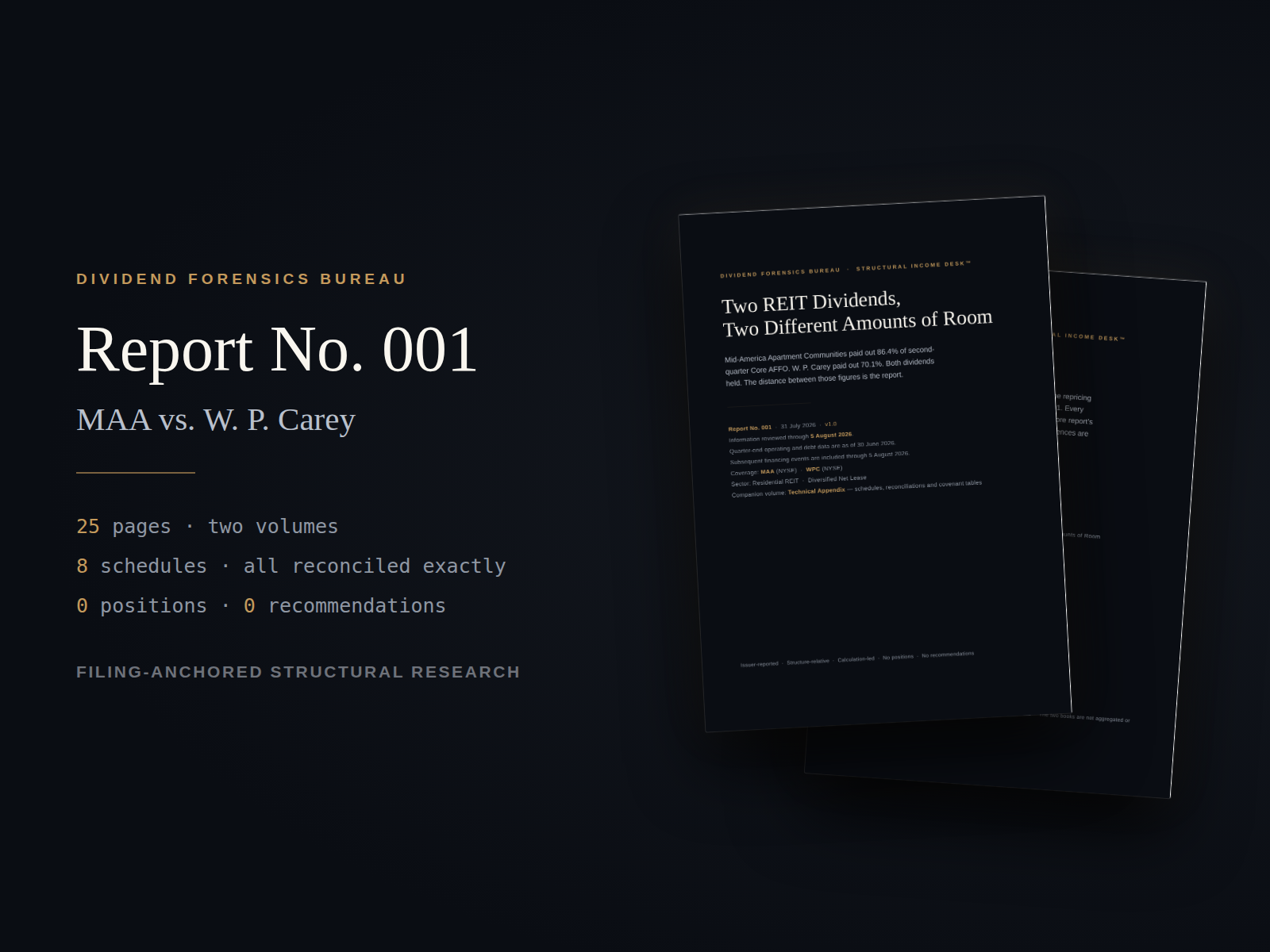
MAA and W. P. Carey, read on each issuer's own adjusted measure. The conclusion comes with the working papers behind it.